Roof moss can look like a minor issue when viewed from the ground, but loose moss can create problems for the whole rainwater system. When rain, wind and weather loosen moss from a roof, pieces can travel down the roof surface and collect at the roof edge. From there, they can enter the gutter channel and mix with leaves, dirt, twigs and other organic debris.
Over time, roof moss in gutters can reduce the space available for rainwater. It may also collect around outlets and downpipes, where a relatively small amount of debris can cause a much bigger drainage problem.
This is especially worth considering in Merseyside, where changing weather, rainfall, mature trees and older properties can all contribute to gutter debris. Homes in Liverpool, Wirral, Sefton, Knowsley, St Helens and Halton can all experience problems when roof debris is allowed to build up.
Understanding the connection between your roof and gutters can make property maintenance easier. A roof does not work separately from the gutter system. Water and loose debris move from one area to another, so keeping one part clean while ignoring the other may not solve the underlying problem.
For local gutter maintenance, Merseyside Gutters provides cleaning, inspection and gutter repair services across Merseyside.
How Moss Moves From the Roof Into Gutters
Moss normally grows where moisture remains on the roof for long periods. Shaded roof areas, older roofing materials and damp conditions can encourage moss growth.
Once moss becomes established, it can loosen naturally. Rainfall can wash small pieces towards the roof edge. Strong winds can also disturb loose growth and roofing debris.
When this happens, roof moss in gutters can become a regular source of blockage material.
The process is often gradual. A small amount of moss may enter the gutter during one period of rain and remain there. More moss arrives during later rainfall. Leaves and other debris then become trapped in the wet material.
The result can be a thick layer of organic debris rather than a simple collection of dry leaves.
This is one reason why homeowners may clean their gutters and then notice the same problem returning relatively quickly. If loose moss is still coming from the roof, the gutter can continue receiving new debris after cleaning.
The roof therefore becomes an important part of the overall drainage picture.
When assessing moss debris gutters, it is useful to consider where the debris is coming from rather than looking only at the gutter itself.
Why Moss Can Hold Water
Moss is naturally associated with damp environments, and some types of moss can retain significant amounts of water. According to Wikipedia, certain sphagnum mosses can absorb many times their own weight in water. Learn more about moss on Wikipedia.
This does not mean every piece of moss inside a domestic gutter behaves in exactly the same way. However, wet moss can form a dense, sponge like mass when mixed with leaves, mud and other organic material.
This matters because a gutter is designed to move rainwater freely towards its outlet.
When wet moss occupies part of the gutter channel, less space remains for water. During light rain, this may not be obvious. During heavier rainfall, however, the reduced capacity can become much more noticeable.
Water may rise inside the channel, especially if the material has collected close to the outlet.
In this situation, roof moss in gutters can contribute to slow drainage and standing water.
Wet organic debris can also become heavy. A gutter containing moss, mud and retained water may place more load on the gutter system than a clean, empty channel.
That additional weight can matter when gutters are already old, poorly supported or affected by damaged brackets.
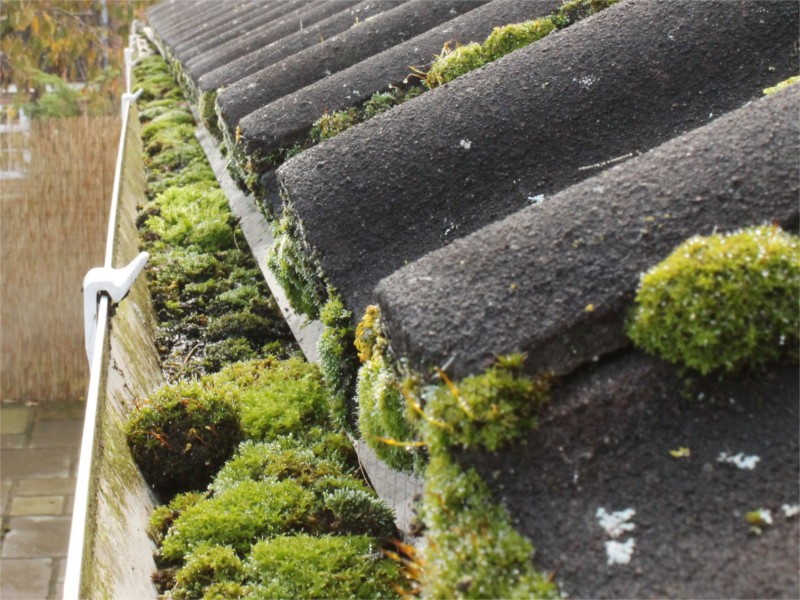
Moss Buildup Inside Gutter Channels
Gutter channels are designed to collect and direct rainwater, not to store soil and organic material.
Unfortunately, once moss enters a gutter, it can create a suitable surface for other debris to settle against. Leaves may become trapped in the moss. Small twigs can sit across it. Fine roof grit and dirt can settle into the wet material.
Over time, this can produce a compact layer of moss debris gutters that is much harder for rainwater to move through.
The location of the buildup is also important.
If debris is spread along a long gutter run, water may still find a path around it during light rainfall. If it gathers at the outlet, the effect can be much more serious.
This is why a gutter does not necessarily have to look completely full to have a drainage problem.
A relatively small blockage at an outlet can restrict the flow from a much larger roof area.
A good gutter cleaning should therefore focus on the gutter channel, outlet and downpipe rather than simply removing what is easiest to reach.
Merseyside Gutters explains that proper gutter cleaning involves removing materials such as leaves, moss, mud and roof debris while also checking areas around outlets and downpipes. You can read more in the company’s guide to how to clean roof gutters.
Blocked Outlets and Downpipes
One of the most important parts of a gutter system is the outlet where water enters the downpipe.
When roof moss in gutters reaches this area, it can collect around the opening. Additional leaves and dirt may then become trapped against the moss.
A blockage at this point can prevent water from leaving the gutter efficiently.
The problem can continue further down the system if moss and organic debris enter the downpipe.
A partially blocked downpipe may still allow some water through, so the issue can remain hidden until rainfall becomes heavier.
You may then notice water backing up inside the gutter or spilling over one section.
Blocked outlets can be particularly troublesome because they affect the flow of water from the whole gutter run feeding that outlet.
A useful inspection should therefore consider:
The gutter channel
Is debris sitting throughout the gutter or mainly around one location?
The outlet
Is water able to enter the outlet freely?
The downpipe
Is there evidence that water is draining slowly or backing up?
The joints
Are there leaks where gutter sections meet?
The brackets
Is the gutter sagging under the weight of debris and retained water?
Looking at these areas together gives a better understanding of the problem.
Overflow Caused by Moss Debris
Gutter overflow is one of the clearest signs that something may be wrong with the drainage system.
During rainfall, water should travel from the roof into the gutter and then through the outlet and downpipe. When roof moss in gutters restricts this route, water can rise until it reaches the gutter edge.
The result may be water pouring over the front of the gutter.
Some homeowners notice this only during particularly heavy rain. Others may see a smaller but regular overflow from the same section of gutter.
The location of the overflow can provide a useful clue.
If the water spills over near an outlet, the outlet or downpipe could be restricted. If the overflow occurs at a joint, the connection may need attention. If the whole gutter is overflowing, a larger blockage or drainage issue may be involved.
Overflow should not simply be ignored.
Repeated water running down exterior walls can contribute to staining and damp conditions. Depending on the construction of the building, persistent moisture may also affect render, brickwork, fascia boards and other roofline components.
A blocked gutter can also allow water to fall onto paths, entrances and other areas around the property.
Merseyside Gutters has written further guidance on why gutters overflow in one place, including other possible causes such as blocked outlets, damaged guttering, poor alignment and restricted downpipes.
Why Roof and Gutter Maintenance Are Connected
It is easy to think of roof cleaning and gutter cleaning as two completely separate jobs.
In practice, they are connected by water and debris.
Rain falls onto the roof. Water moves towards the roof edge. Loose materials can travel with that water. The gutter catches both the rainfall and some of the material leaving the roof.
This means a roof with heavy loose moss can place an additional debris load on the gutter system.
That does not mean every roof with moss needs immediate roof treatment. Roof materials vary, and the correct approach depends on the condition and construction of the roof.
However, the gutter should still be checked when loose moss is visible or when moss debris gutters are becoming a repeated problem.
A simple example is a property where the gutters are cleaned in autumn but become full of moss again within a short time. Cleaning the gutter repeatedly may help, but understanding why the material keeps returning could be more useful.
Roof condition should be part of the inspection.
The same principle applies when roof moss is removed. The work can disturb additional loose material, which may then travel into the gutter.
That leads to an important maintenance question.
Should the gutters be checked after roof moss removal?
In many cases, yes.
Signs of a Moss Related Blockage
A moss related gutter blockage does not always appear as an obvious pile of green material.
Some signs are more subtle.
Water spilling over the gutter
Overflow during rainfall is one of the most common warning signs. It may occur because moss and other material have reduced the flow through the gutter or outlet.
Slow draining downpipes
If a downpipe is partially restricted, water may continue moving but at a much slower rate.
Wet moss visible inside the gutter
If you can safely view the gutter from ground level and see thick organic material, the system may need cleaning.
Plants growing from the gutter
Grass or small plants can indicate that soil, decomposed leaves and moss have been sitting in the gutter for a long time.
Dark staining below the gutter
Repeated overflow can leave marks on exterior surfaces.
Water dripping from joints
A leak at a joint does not always mean the joint itself is the original problem. Water backing up because of a blockage can sometimes escape from weak points.
Sagging gutter sections
Heavy wet debris can add weight to the gutter. Existing problems with brackets or alignment may become more noticeable.
Repeated blockages
If the gutter keeps becoming blocked after cleaning, look beyond the visible debris. Heavy roof moss, nearby trees, damaged guttering and drainage problems may all contribute.
These signs are worth taking seriously because early action can be simpler than dealing with damage after repeated overflow.
How Roof Moss Removal Can Affect Gutters
Roof moss removal can help reduce the amount of loose moss available to enter a gutter, but the process itself may disturb existing growth.
When moss is removed from a roof, loosened material can fall towards the roof edge.
Some of this may enter the gutters.
For this reason, gutter cleaning should form part of the wider maintenance plan when significant roof moss has been removed.
This is especially important for properties where gutters already contain older organic debris.
After roof work, it can be sensible to check:
- The gutter channel for loose moss.
- The outlets for compacted debris.
- The downpipes for restricted flow.
- The roof edge for additional loose material.
- The fascia and soffit area for signs of water problems.
The wider aim is to make sure the rainwater system remains clear after the roof has been disturbed.
A clean roof with a blocked gutter is not a complete maintenance solution.
Should You Clean Gutters After Roof Moss Removal?
In many situations, cleaning or at least checking the gutters after roof moss removal is sensible.
This is because loose moss may fall into the gutter during the work.
If the roof had heavy moss growth before treatment, the quantity of debris can be more significant.
Cleaning the gutter afterwards helps remove material that may otherwise settle around outlets and downpipes.
It can also provide an opportunity to inspect the gutter system for other issues.
This is particularly useful for older homes across Liverpool and wider Merseyside, where rooflines may have several gutter runs, extensions, valleys and different drainage points.
Homeowners should also remember that roof moss removal and gutter cleaning are not automatically the same service. The safest method depends on the type and condition of the roof and gutter system.
Where access is difficult, professional help is often the sensible option.
When Professional Cleaning Is Useful
There are situations where professional gutter cleaning Liverpool services can make the job safer and more thorough.
Working at roof height can present a fall risk, particularly on steep or slippery surfaces.
Gutters can also be difficult to reach on three storey homes, extensions, conservatories and properties with awkward roof layouts.
Professional equipment may allow a gutter to be inspected and cleaned without unnecessary roof access.
Professional cleaning can also be helpful when the blockage is not obvious.
For example, you may see water overflowing from one area but have no idea whether the cause is:
- A blockage in the gutter.
- A blocked outlet.
- A blocked downpipe.
- A damaged section.
- Poor gutter alignment.
- Heavy roof debris.
- Several problems occurring together.
An experienced gutter cleaner can assess the system rather than simply removing the visible material.
Merseyside Gutters provides gutter cleaning and related gutter services across Liverpool and the wider Merseyside area. The company covers areas including Liverpool, Wirral, Sefton, Knowsley, St Helens and Halton. Its service includes clearing gutter debris and checking the system for problems that may affect water flow.
You can learn more about the local service here: Gutter Cleaning Merseyside.
Why This Matters for Homes Across Merseyside
Merseyside properties can experience a mixture of weather and environmental conditions that affect roof and gutter maintenance.
Rainfall can carry debris from roofs into gutter channels. Wind can move leaves and loose roofing material. Properties near mature trees may receive additional organic debris.
Older roofs may also have greater amounts of moss growth than newer roofs, although the condition varies from property to property.
The result is that roof moss in gutters can become an ongoing maintenance issue rather than a one time problem.
Different parts of Merseyside may have different property styles, but the basic drainage principle remains the same.
Rainwater needs a clear route away from the roof.
A gutter full of moss, leaves and mud cannot perform that job as effectively as a clear system.
This is why regular inspection can be valuable even when the gutter appears fine from the ground.
For homeowners in Liverpool, Wirral, Southport, Formby, Huyton, Kirkby, Bootle, St Helens and surrounding areas, local gutter maintenance can help identify problems before they become more serious.
For example, Merseyside Gutters provides local services such as Gutter Cleaning Formby and Gutter Cleaning Huyton, showing how gutter care can be adapted to different residential areas.
How Often Should Gutters Be Checked?
There is no single cleaning schedule that suits every property.
A home under large trees may collect leaves much faster than a property in an open area.
A roof with heavy moss may also introduce more debris into the gutters.
Some homes may benefit from checks twice a year, while properties with recurring blockages may need more frequent attention.
Spring and autumn are often sensible times to inspect gutters because debris can build up during changing weather and after periods of leaf fall.
However, visible warning signs should not be ignored simply because the next planned cleaning date has not arrived.
If water is overflowing, a downpipe appears blocked or thick moss debris gutters are visible, the system may need attention sooner.
The right schedule depends on the property, roof condition, surrounding trees and previous maintenance history.
Preventing Roof Moss From Becoming a Gutter Problem
You cannot always prevent moss from growing on a roof, especially where conditions are naturally damp or shaded.
However, you can reduce the chance of moss becoming a serious gutter problem by paying attention to the whole roofline.
Regularly inspect the roof from a safe position.
Look for loose moss around roof edges.
Check gutters for organic debris.
Watch how water flows during rainfall.
Arrange professional checks where access is difficult.
Do not push large amounts of debris into downpipes during DIY cleaning.
Do not walk on a roof simply to inspect moss.
Do not ignore repeated overflow.
Good maintenance is usually about identifying small problems before they become larger ones.
The Link Between Moss, Gutters and Water Damage
A blockage does not automatically mean a property will suffer serious damage.
However, repeated uncontrolled water flow can increase the risk of problems around the roofline.
Water that should travel through the gutter may instead run down walls, behind gutter sections or over paths.
Depending on the property, prolonged moisture can contribute to staining, damp areas, damaged finishes and deterioration of roofline components.
The cost of cleaning a gutter is generally much easier to manage than repairing a larger water related problem.
This is one reason why professional maintenance can be useful for homeowners who do not have safe access or who have recurring blockages.
Merseyside Gutters offers gutter cleaning, repairs, installation and fascia and soffit services for residential and commercial properties. The company also provides digital photos where suitable, helping property owners understand the condition of their gutters.
Why Merseyside Gutters Can Help
Merseyside Gutters focuses on gutter cleaning and roofline maintenance across Merseyside.
For a homeowner dealing with roof moss in gutters, the goal should not simply be to remove visible moss.
A useful inspection should consider the complete route that rainwater follows.
That means checking the gutter channel, outlets and downpipes while also considering the roof condition and the source of recurring debris.
Merseyside Gutters serves properties across Liverpool, Wirral, Sefton, Knowsley, St Helens and Halton.
The company provides gutter cleaning, gutter repairs, gutter and downpipe installation, fascia and soffit installation and fascia and soffit cleaning.
You can visit the Merseyside Gutters website to learn more about the available services or contact Merseyside Gutters about a gutter problem at your property.
The company can be particularly useful when gutters are difficult to access, blockages keep returning or you are unsure whether the problem is caused by moss, leaves, a downpipe or damaged guttering.
Frequently Asked Questions
Can roof moss block gutters?
Yes. Roof moss in gutters can contribute to blockages, especially when loose moss mixes with leaves, mud, twigs and other organic debris. The material can collect around gutter outlets and restrict the flow of rainwater into the downpipe.
A blockage may be particularly noticeable during heavy rain when a restricted gutter cannot move water quickly enough.
Does moss hold water inside gutters?
Wet moss can retain water, and when it mixes with other organic debris it may form a dense layer inside the gutter. Some species of moss have a strong ability to retain moisture.
Inside a gutter, this can reduce the space available for rainwater and contribute to slow drainage.
Should gutters be cleaned after roof moss removal?
Yes, checking the gutters after roof moss removal is often a sensible part of the maintenance process. Removing moss from a roof can disturb loose material, which may fall into the gutter.
Cleaning the gutter afterwards helps remove this debris before it collects around outlets or enters the downpipe.
Can roof moss cause a gutter to overflow?
Yes. Roof moss in gutters can contribute to overflow when moss combines with leaves, mud and other debris. If the outlet becomes restricted, rainwater may build up inside the gutter and spill over the edge.
However, overflow can also have other causes, including damaged guttering, poor alignment and blocked downpipes.
How do I know if moss is blocking my downpipe?
One possible sign is water remaining in the gutter or overflowing during rainfall while the downpipe appears to discharge very little water.
A downpipe blockage is not always visible from the outside. A professional inspection can help establish whether moss, leaves, mud or another issue is restricting the pipe.
Is roof moss always a serious problem?
Not necessarily. The amount of moss, roof condition and type of roofing material all matter.
The important point is to monitor loose moss and its effect on the gutter system. Heavy moss growth combined with recurring gutter blockages deserves more attention than a small amount of growth with no drainage problems.
How often should gutters be cleaned in Merseyside?
The ideal schedule depends on the property. Homes surrounded by trees or properties with heavy roof moss may need more regular checks.
Many homeowners choose spring and autumn for routine maintenance, while properties with recurring blockage or overflow may need additional inspections.
Can I clean moss from my gutters myself?
Some low level gutter cleaning may be possible with suitable equipment, but working at height can be dangerous.
It is important not to stand on a roof simply to reach the gutter, particularly when the roof or moss is wet.
Professional gutter cleaning can be a safer option for high, awkward or difficult to access properties.
Does gutter cleaning remove roof moss?
Gutter cleaning removes the moss and debris that have entered the gutter. It does not necessarily remove moss growing on the roof itself.
If the roof continues shedding loose moss, the gutter may become blocked again. The roof and gutter therefore need to be considered together.
What should I do if my gutters keep filling with moss?
Repeated roof moss in gutters may indicate that loose moss is continually falling from the roof.
The gutter should be cleaned, but it is also useful to inspect the roof edge and consider the condition of the roof itself.
Merseyside Gutters can help inspect and clean the gutter system and advise when further roofline or gutter work may be needed.
What areas does Merseyside Gutters cover?
Merseyside Gutters provides services across Merseyside, including Liverpool, Wirral, Sefton, Knowsley, St Helens and Halton.
The company also has local service pages for areas such as Formby and Huyton.
For reliable help with roof moss in gutters, gutter blockage, overflow or general gutter maintenance, contact Merseyside Gutters to discuss the condition of your property.