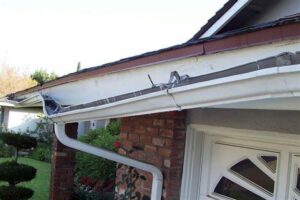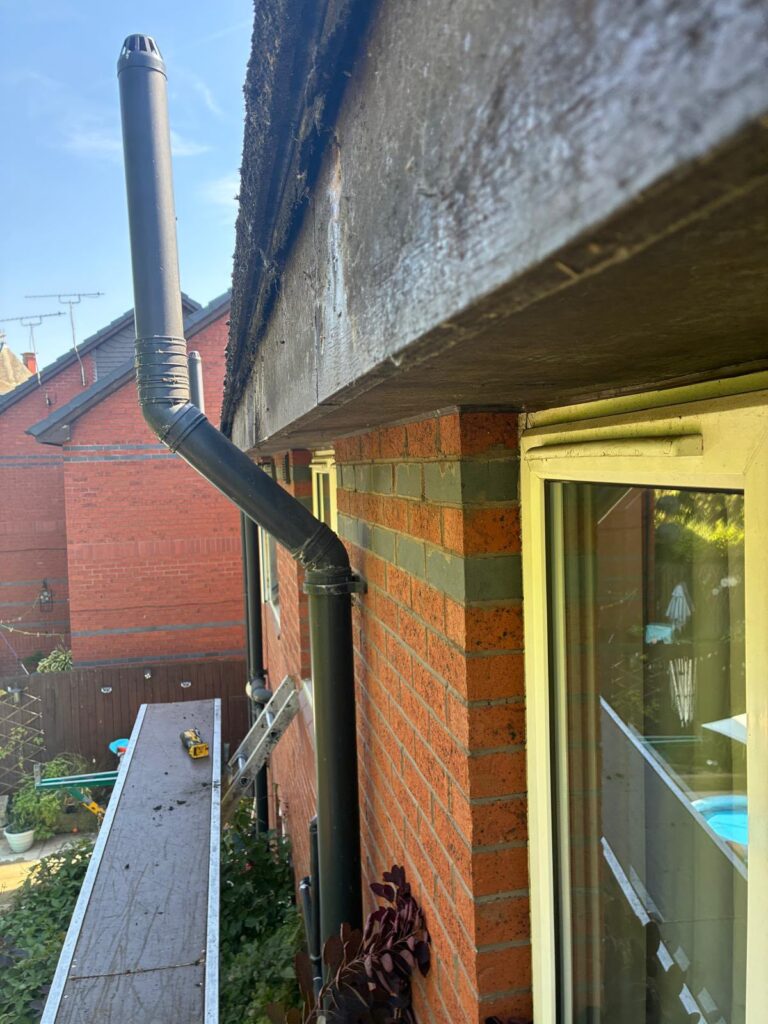
A downpipe leaking at bottom can look like a small problem, especially when the water is only dripping from the lower section of the pipe. However, a leak at the bottom can sometimes point to a blockage, damaged joint, loose connection, or water flow problem higher up in the gutter system.
A downpipe has an important job. It carries rainwater from the gutter down towards a drain or another suitable outlet. When the system is working properly, rainwater should move through the gutter and downpipe without escaping from joints or collecting around the base of the property. A downspout, also commonly called a downpipe in the UK, is designed to carry rainwater from a roof gutter towards ground level. Wikipedia explains the role of a downspout here.
If you notice a downpipe leaking at bottom, it is worth finding out why before ignoring it. Repeated leaking water can leave marks on walls, damage pointing, contribute to damp around the lower part of a building and create poor drainage around the property.
For homeowners across Merseyside, Merseyside Gutters provides gutter cleaning, gutter repairs and downpipe related services. The team can inspect the system, identify the cause of the leak and recommend the most suitable solution.
What Does It Mean When a Downpipe Is Leaking at the Bottom?
When you have a downpipe leaking at bottom, water may appear around the final joint, the bottom bend, the shoe or the point where the pipe meets the drain.
The location of the water does not always tell you where the problem started.
For example, water from a blocked downpipe may build up inside the pipe and escape through the lowest weak joint. A joint may look like the source of the leak even though the real issue is further up the system.
This is why it is important to inspect the complete gutter and downpipe rather than simply sealing the visible drip.
A leaking downpipe can become more noticeable during heavy rain. You may see water spraying from a joint, dripping down the wall or collecting around the base of the building.
The good news is that many downpipe problems can be repaired when they are found early.
Common Reasons for a Downpipe Leaking at Bottom
There are several reasons you may have a downpipe leaking at bottom. Some are simple issues, while others may need professional repair.
The most common causes include blockages, damaged seals, cracked sections, loose clips, movement in the pipe and water backing up from a gutter.
Understanding the cause makes it easier to choose the right repair.
Blockages Inside the Pipe
A blockage is one of the most common reasons for a downpipe leaking at bottom.
Rainwater needs a clear route from the gutter to the drain. Leaves, moss, mud, roof grit, small twigs and other debris can collect inside the gutter outlet or downpipe.
When water cannot move freely, it begins to build up.
The pressure created by standing water may force rainwater through a weak joint or damaged connection. In some cases, the water may come out from the bottom bend even though the actual blockage is higher up.
This is why a leaking downpipe should not always be treated as a simple seal problem.
A blockage may also cause the gutter above the downpipe to overflow. You may notice water spilling over the front of the gutter before you notice the lower pipe leaking.
If your property has trees nearby, regular gutter cleaning can be particularly useful. Leaves can enter the roof drainage system throughout the year, while moss can break away from the roof and collect around the gutter outlet.
Merseyside Gutters provides gutter cleaning across Merseyside and can check the gutter outlet and downpipe when a drainage problem is suspected.
For more information, see the gutter cleaning service from Merseyside Gutters.
Damaged Downpipe Joints
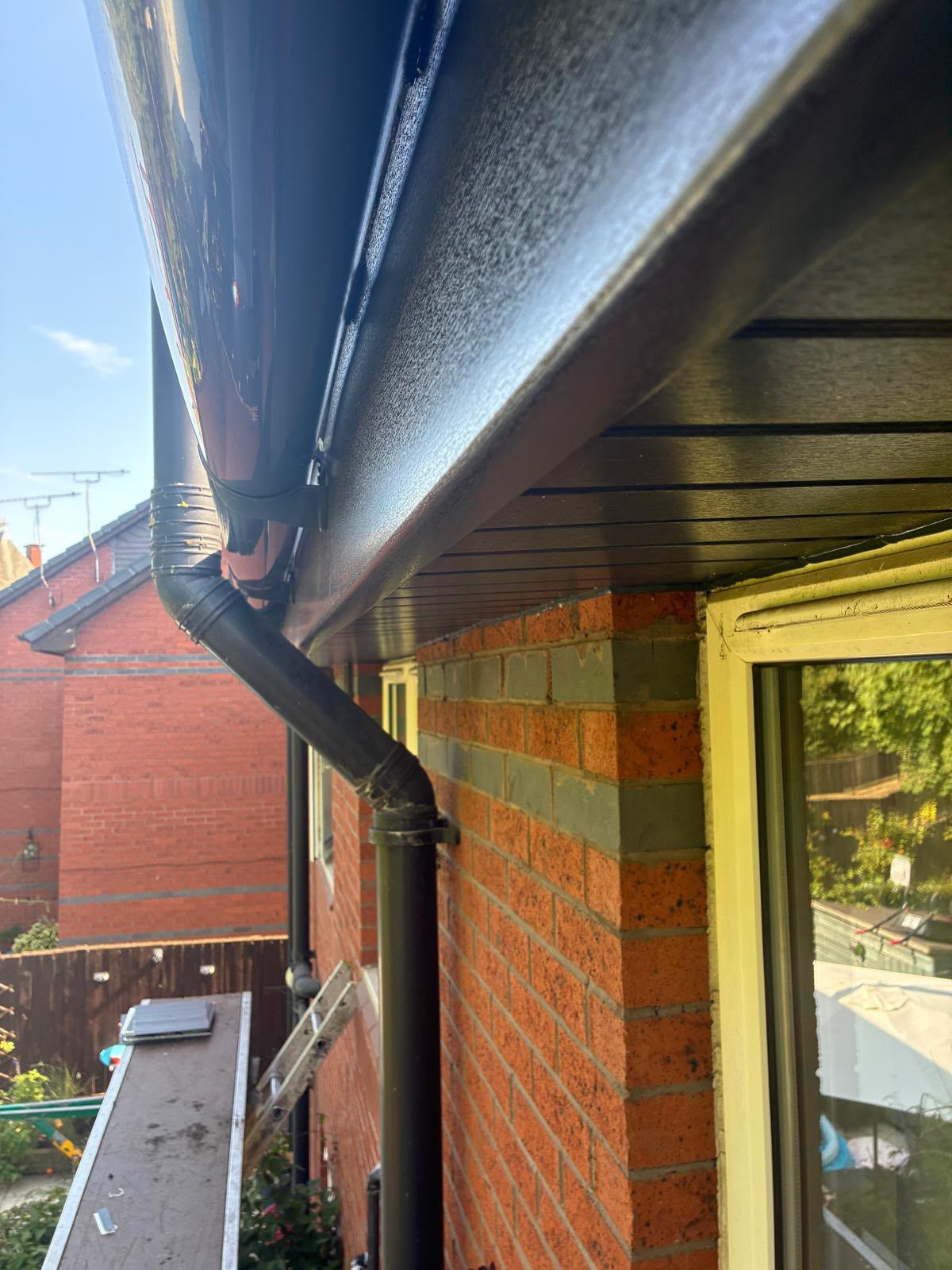
A downpipe joint leak is another common cause of a downpipe leaking at bottom.
Most downpipe systems are made from sections joined together with fittings and clips. Depending on the system, seals may help create a watertight connection.
Over time, these seals can become worn. Plastic fittings can also become cracked or damaged, especially after years of exposure to changing weather conditions.
A joint may also move slightly if the pipe has been knocked or if a fixing has become loose.
You may notice a drip directly from the joint when it rains. If the leak is severe, water may run down the outside of the pipe and collect near the bottom.
Small joint problems can sometimes be repaired by replacing the damaged section or fitting. If the joint has become brittle or cracked, replacing the fitting is usually a better solution than repeatedly applying sealant.
A proper inspection should also check whether the pipe is correctly aligned. A badly positioned section may place unnecessary pressure on the joint and cause the leak to return.
Loose Connections and Pipe Clips
A downpipe leaking at bottom may also be caused by a loose connection.
Downpipes are normally held against the wall with brackets or clips. These keep the pipe in position and help prevent movement.
If one or more clips become loose, the pipe can move when water passes through it or when the wind puts pressure on the system.
Movement can gradually loosen the connections between sections.
A loose fitting may not leak during light rain. The problem may become obvious during heavier rainfall when more water is moving through the pipe.
Check for visible movement, gaps between fittings and sections that appear to have pulled apart.
If the pipe is high up, awkward to reach or attached to a two storey property, it is safer to have it inspected professionally rather than trying to reach it with an unsuitable ladder.
Merseyside Gutters handles gutter and downpipe problems across Merseyside, including properties in Liverpool, Wirral, St Helens, Sefton, Knowsley and Halton.
Water Backing Up From the Gutter
Sometimes a downpipe leaking at bottom is caused by a problem above it.
Your gutter may be full of leaves, moss, dirt or other debris. If the water cannot enter the downpipe properly, it can begin to back up.
This can create pressure around the outlet and the first section of the pipe.
The gutter may also have poor alignment. If the gutter is sagging, rainwater may collect in one section instead of flowing naturally towards the downpipe.
A blocked gutter outlet can produce several warning signs.
You might notice the gutter overflowing during rain. There may also be water marks on the wall, damp patches around the roofline or a steady stream of water coming from an unexpected location.
This is why checking only the bottom of the downpipe can miss the real cause.
A complete inspection should look at the gutter channel, outlet, joints, brackets, downpipe sections and lower connection.
Merseyside Gutters provides professional gutter repair services and can investigate the wider system when a drainage problem keeps returning.
You can also read the Merseyside Gutters gutter repair service page to learn more about common gutter and downpipe problems.
How to Tell If You Have a Leaking Downpipe
A downpipe leaking at bottom is usually easy to spot during or shortly after rainfall.
Water may drip from the lower joint or run down the outside of the pipe.
You may also see water collecting around the bottom of the wall.
Other signs can include:
- Water staining on brickwork
- Damp marks near the lower wall
- Moss or algae growing where water repeatedly lands
- Standing water near the base of the property
- A visible split in the pipe
- A joint that appears to have opened
- Water escaping from the pipe during heavy rain
- A gutter overflowing at the top
Some leaks are much easier to identify when it is raining because the flow of water makes the problem obvious.
However, do not assume that the lowest visible leak is the only problem. Water can travel along the outside of a pipe or wall before reaching the point where you notice it.
Could a Gutter Drainage Problem Cause a Leak?
Yes. A gutter drainage problem can contribute to a downpipe leaking at bottom.
The gutter and downpipe work together as one rainwater system. When one part stops working correctly, the other part can be affected.
Imagine a gutter filled with wet leaves. Rain falls onto the roof and enters the gutter, but the water cannot pass through the blocked outlet quickly enough.
The water starts to build up.
Eventually, it may overflow over the gutter edge or force its way through a weak connection.
Now imagine that the blockage is inside the downpipe rather than the gutter. Water enters the top of the pipe but cannot travel down. It builds up until it escapes through a joint.
This is why professional inspection is useful when the same leak appears again and again.
Signs of a More Serious Downpipe Problem
Most leaks should be checked, even when they appear minor. A downpipe leaking at bottom can sometimes indicate a wider drainage or roofline issue.
Look out for signs such as repeated leaks after repairs, large cracks, damaged fittings, sagging gutters, water pooling near the building, damp walls or a pipe that is pulling away from the wall.
Another warning sign is water appearing around the property even when the downpipe itself looks intact.
This could indicate a blocked underground drain or another drainage problem rather than a simple downpipe fault.
The condition of the surrounding wall can also tell you something.
If one area of brickwork is regularly wet, stained or covered with green growth, water may be hitting the same spot repeatedly.
Over time, persistent water exposure can create problems for exterior surfaces and may contribute to damp conditions.
The sooner the cause is found, the easier it may be to deal with.
Can Cleaning Fix a Downpipe Leak?
Cleaning can solve the problem when a blockage is responsible.
If you have a downpipe leaking at bottom because leaves and debris are stopping water from draining, clearing the blockage may restore normal flow.
However, cleaning will not repair a cracked pipe or damaged joint.
This is an important difference.
A dirty downpipe needs clearing.
A cracked downpipe needs repair or replacement.
A loose connection needs securing.
A damaged seal may need replacing.
A blocked gutter needs proper cleaning.
The right answer depends on what the inspection finds.
For this reason, cleaning and inspection often go hand in hand.
How Professionals Inspect a Leaking Downpipe
When investigating a downpipe leaking at bottom, a careful inspection should start from the gutter and work down towards the drain.
The gutter outlet should be checked for leaves and other debris.
The upper downpipe should then be assessed for visible damage or signs of blockage.
Joints should be examined for gaps, movement and worn seals.
Brackets and clips should be checked to make sure the pipe is firmly supported.
The lower bend and shoe should also be inspected because these sections can collect mud and debris.
Finally, water flow should be checked where possible.
The aim is not simply to stop the visible drip. The aim is to find the reason water is escaping.
This is where the experience of a professional gutter company can be valuable.
Why Regular Gutter Cleaning Matters in Merseyside
Merseyside properties are exposed to frequent rainfall, changing weather conditions, wind and seasonal debris.
Homes surrounded by trees can collect leaves in gutters, while roof moss can add more organic material to the drainage system.
If this material is not cleared, it can move towards the downpipe outlet and restrict water flow.
Regular cleaning helps reduce the risk of blocked gutters and downpipes.
It also provides an opportunity to spot damaged gutter sections, loose fittings and early signs of leaks.
Merseyside Gutters provides gutter cleaning and gutter maintenance across Merseyside, including Liverpool and surrounding areas.
The company also provides gutter repairs when cleaning identifies a problem that needs more than simple debris removal.
When Does a Leaking Downpipe Need Repair?
A downpipe leaking at bottom should usually be repaired when the pipe, connection or fitting is damaged.
Repair may be necessary when you find a cracked section, broken joint, worn seal, loose connection or damaged bracket.
Repeated leaks are another strong reason to investigate the system.
You might have sealed the same area before, only for the leak to return after a few weeks or during the next heavy rainfall.
That usually means the underlying problem has not been fully resolved.
A professional repair may involve replacing a damaged joint, fitting a new pipe section, securing a loose bracket, clearing a blockage or correcting the alignment of the system.
In some cases, replacement may make more sense than repair, especially if the downpipe is old and has several damaged areas.
Can You Repair a Downpipe Yourself?
Some small downpipe issues can be dealt with by a capable homeowner when the pipe is easy to reach and the problem is obvious.
For example, a loose connection at ground level may be simple to identify.
However, care is needed with anything involving ladders, roof edges or upper sections of the property.
A temporary seal may also not be the best long term solution.
If the pipe is cracked, badly damaged or repeatedly leaking, professional inspection is a safer choice.
You also need to consider the cause. Replacing a fitting will not solve a hidden blockage higher up in the system.
A good repair should solve the cause as well as the visible symptom.
Merseyside Gutters Can Help With Leaking Downpipes
If you have a downpipe leaking at bottom, Merseyside Gutters can help identify the cause and recommend a practical solution.
Merseyside Gutters provides gutter cleaning and repair services across the region, helping residential and commercial customers deal with leaking gutters, blocked downpipes, damaged sections and drainage issues.
The company serves areas across Merseyside, including Liverpool, Wirral, Birkenhead, Wallasey, St Helens, Southport, Bootle, Crosby, Formby, Prescot, Huyton, Kirkby, Maghull, Aintree, Speke, Garston, Allerton and surrounding locations.
The team can inspect the condition of the gutter system and check whether the leak is connected to a blockage, damaged joint, loose fitting or another issue.
Merseyside Gutters also provides gutter repairs in Liverpool for customers dealing with leaking, loose or damaged gutter systems.
Early action can often prevent a minor drainage problem from becoming a bigger repair.
What Should You Do If Your Downpipe Is Leaking?
The first step is to observe where the water is coming from.
Do not immediately assume that the lowest dripping point is the source.
Check whether the gutter is overflowing.
Look for visible debris around the gutter outlet.
Look for cracks or gaps in the pipe.
Check whether any joints appear loose.
Watch how water moves during rainfall.
Look for water collecting around the base.
If it is safe to do so, you can inspect the lower section of the pipe from ground level.
Avoid climbing onto the roof or using an unstable ladder to investigate a problem that can be assessed safely by a professional.
Once the cause is known, the correct solution becomes much clearer.
Frequently Asked Questions
Why does my downpipe leak at the bottom?
A downpipe leaking at bottom may be caused by a blockage, damaged joint, worn seal, loose connection, cracked pipe or water backing up from the gutter. The bottom section is often where escaping water becomes visible, but the actual cause may be further up the system.
Checking the gutter, outlet, pipe joints and lower section can help identify the problem. If the leak keeps returning, professional inspection is recommended.
Can a blockage cause a downpipe to leak?
Yes. A blockage can stop rainwater from travelling through the downpipe. Water may then build up and escape through a weak joint or damaged section.
Leaves, moss, dirt and other debris can restrict the flow of water. A blocked gutter outlet can create the same effect.
If you have a downpipe leaking at bottom, checking for a blockage should be one of the first steps.
Should a leaking downpipe be repaired?
Yes. A leaking downpipe should not usually be ignored, particularly if the problem continues during rainfall.
A small leak can become worse if a joint continues to move or if water is repeatedly hitting the same part of the wall.
Repairing the problem early can help keep rainwater moving away from the property and reduce the chance of further damage.
Why is my downpipe leaking only when it rains heavily?
Heavy rain puts more water through the gutter and downpipe. If the system has a partial blockage, damaged joint or poor flow, the greater amount of water can expose the problem.
A pipe that appears fine during light rain may leak during a heavy shower because the system is working closer to its full capacity.
Can a leaking downpipe cause damp?
It can contribute to damp conditions if water repeatedly runs onto walls or collects against the base of a building.
A single short leak does not automatically mean there is serious damp damage, but repeated exposure should be investigated.
If damp is already present inside the property, other causes should also be considered.
How often should downpipes be checked?
There is no single schedule that works for every property. Homes with trees nearby or heavy moss growth may need more frequent checks.
It is sensible to inspect gutters and downpipes as part of regular property maintenance and especially after periods of heavy rain or storms.
Can gutter cleaning prevent downpipe leaks?
Gutter cleaning can reduce the risk of leaks caused by debris and blockages.
Keeping the gutter and outlet clear allows rainwater to enter the downpipe more easily.
However, cleaning cannot repair cracked pipes or damaged joints, so physical damage still needs attention.
A downpipe leaking at bottom should not be ignored just because the leak appears small.
The cause could be as simple as a blockage, but it may also involve a damaged joint, loose connection, poor gutter flow or cracked pipe.
The most important thing is to find the cause rather than repeatedly treating the visible drip.
Keeping gutters clean, checking downpipes after heavy rainfall and dealing with damaged fittings early can help maintain proper rainwater drainage.
For homeowners and businesses across Merseyside, Merseyside Gutters can inspect and deal with gutter and downpipe problems before they become more difficult to manage.
When you notice a downpipe leaking at bottom, getting the system checked early can provide peace of mind and help keep rainwater moving where it should.
Need Help With Your Leaking Downpipe?
Merseyside Gutters provides professional gutter cleaning, gutter repairs and downpipe services across Merseyside. If your downpipe leaking at bottom problem keeps coming back, a proper inspection can help identify the real cause.
Visit Merseyside Gutters at merseysidegutters.com and get in touch to discuss your gutter or downpipe problem.