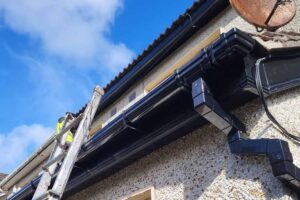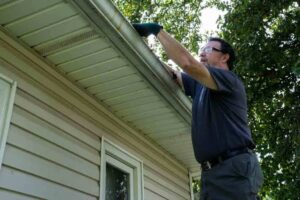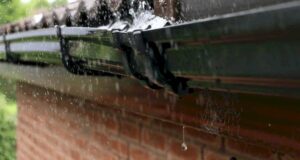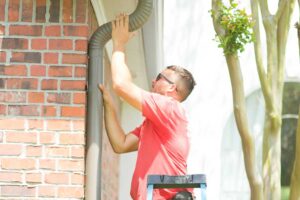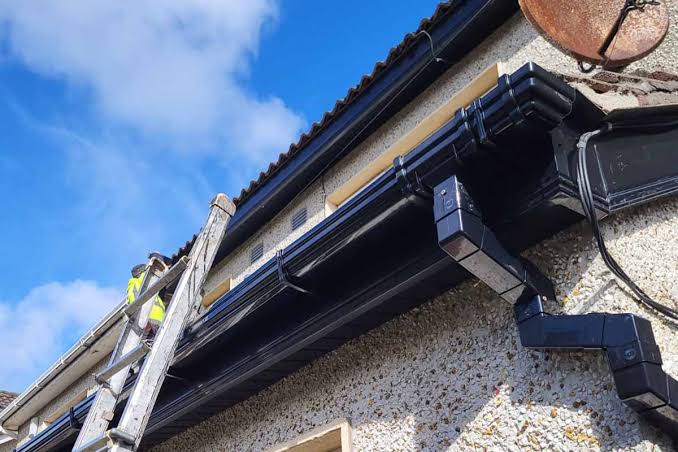
Knowing how to repair guttering starts with finding out why it has moved. Sagging gutters need checks of their brackets, screws, supporting fascia and drainage alignment. Sealing a nearby leak may stop a drip for a while, but it will not correct a loose support or a low section holding water.
The right repair depends on what has failed. Sound guttering may only need new brackets and careful realignment. Cracked or badly twisted sections may need replacing. If the fascia cannot hold the fixings securely, that damage needs attention before the gutter is refitted.
This guide explains what to look for, how repairs are assessed and when professional help makes sense. For homeowners and businesses across Merseyside, Merseyside Gutters offers help with loose, leaking and uneven guttering.
Signs That Guttering Has Moved
A gutter does not have to fall off the roofline before it needs attention. Small changes in its position can affect how rainwater drains.
From ground level, look along the gutter rather than straight up at one section. A dip, twist or sudden change in height can be easier to spot from a little distance.
Common signs include:
- A visible dip between brackets.
- One section leaning forwards.
- Joints sitting at different heights.
- A growing gap between a bracket and the fascia.
- Water spilling over the same section during rain.
- Drips continuing from a joint after rainfall stops.
- Staining on the wall beneath a low point.
Some gutters naturally sit slightly away from the fascia because of their bracket design. A gap alone does not prove that anything is wrong. Look for movement, loose fittings or a change from the gutter’s previous position.
If you are checking how to repair guttering, photograph the affected area from the ground. A wider picture showing the outlet and surrounding roofline is often more useful than a close view of one drip.
Keep people away from any section that appears partly detached. Do not pull on it to check whether it is secure.
Why Gutters Sag or Pull Away
Guttering depends on several parts working together. The channel carries rainwater, brackets support the channel, and fixings transfer that load into a suitable supporting surface.
A weakness anywhere along that chain can allow movement.
For example, a bracket may remain intact while its screws pull out of damaged timber. Elsewhere, the fascia may be sound, but a broken bracket leaves too much gutter unsupported.
Common causes of gutter pulling away include:
- Loose, missing or unsuitable fixings.
- Cracked brackets or damaged retaining clips.
- Too much space between supports.
- Decay in timber fascia boards.
- Poorly secured fascia.
- Debris and trapped water adding weight.
- Distorted gutter sections.
- Previous repairs that left the run uneven.
Several faults can occur together. A blocked outlet may leave water standing in a section that already has weak support.
Understanding how to repair guttering means tracing the movement back to its cause. Replacing a leaking joint without checking the nearby brackets can leave the same problem ready to return.
The aim is a secure gutter run that receives water from the roof and carries it towards a working outlet.
Debris and Standing Water
Leaves, moss and roof debris can collect inside guttering. As the material becomes wet, it adds weight and reduces the space available for rainwater.
A blockage near the outlet can cause water to back up along the run. A local dip can also trap water even when the outlet is clear.
These problems need different repairs.
If the gutter is correctly supported and aligned, clearing the blockage may restore drainage. If a section remains low after cleaning, sagging gutter repair may also be needed.
Debris should be removed rather than pushed into the downpipe, where it can create another blockage. The outlet and the accessible drainage route should also be checked.
Observe the pattern of standing water. A deep pool in the middle suggests a low section or an obstruction. Water backing up from the outlet points towards a restriction further along the drainage route.
Cleaning is an important first step when assessing how to repair guttering, but it does not prove that the supports are sound. Once the channel is clear, the brackets, fascia and alignment still need inspection.
Avoid using the gutter as a handhold or resting access equipment against it.
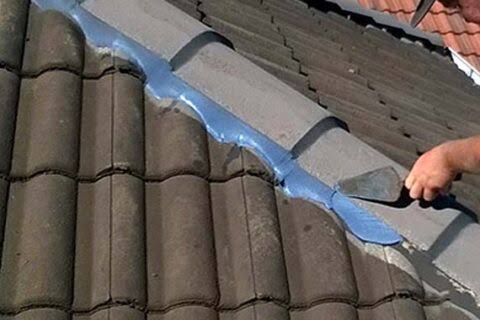
Loose or Broken Brackets
Gutter brackets hold the channel in position. Depending on the system, they may also include clips that keep the gutter seated while allowing the movement required by its design.
A bracket can fail in several ways. Its body may crack, the retaining clip may break, or the fixing may become loose.
Loose gutter brackets can allow a section to drop or twist. That movement can also disturb nearby joints.
The repair depends on the condition of both the bracket and its fixing point. An intact bracket may be reusable if it can be secured correctly into sound material. A cracked support or broken retaining clip usually needs a compatible replacement.
Simply fitting a larger screw into the same damaged hole is not a reliable answer in every case. The surrounding material may no longer provide enough grip.
The inspection should also include neighbouring supports. A failed bracket can leave nearby fittings carrying more load than intended.
When deciding how to repair guttering, check whether the fault affects one support or several along the run. Repeated movement often needs a wider inspection than a single loose screw.
Wire, cable ties and improvised straps should not replace the supports specified for the gutter system.
Checking the Fascia Behind the Gutter
The fascia is the board along the roof edge where many domestic gutter brackets are fixed. It needs to provide a secure fixing arrangement for the gutter system.
If that support is weak, new brackets alone will not solve the problem.
Warning signs include peeling paint, split timber, visible decay, loose boards and fixings that repeatedly pull out. Water staining is also worth investigating, although staining alone does not establish the extent of damage.
A plastic covering can hide the condition of older timber behind it. A tidy outer surface therefore does not always confirm that the supporting material is sound.
Where the fascia has deteriorated, the repair should address the affected board and any damaged backing structure. The cause of repeated wetting should also be investigated.
Learning how to repair guttering includes knowing when the gutter is only part of the work. A sound fixing surface must come before final alignment and refitting.
Merseyside Gutters provides fascia and soffit installation in Merseyside where roofline components need attention. The appropriate work depends on the condition found during inspection.
Understanding Gutter Fall
Gutter fall is the change in height along a gutter run towards an outlet.
Where the system is designed to have a fall, the slope should be controlled and consistent. A local dip can hold water even if both ends appear correctly positioned.
However, there is no single slope that should be applied to every gutter system. Some systems allow level installation, while others have specific recommendations for a fall. Flow capacity also depends on the gutter profile and outlet arrangement.
For example, FloPlast’s guidance allows certain domestic gutters to be installed level or within a stated maximum fall. That guidance should not be treated as a universal rule for other products.
The important point for gutter realignment is to follow the instructions for the actual system.
A gutter that looks straight against the roof edge may still drain poorly. The fascia itself may be uneven, so its edge is not always a reliable guide.
A measured alignment check is more useful than judging the slope by eye. It should establish where water needs to go and whether any section interrupts that route.
For a general explanation of gutter types and their role around a building, see Wikipedia’s page on rain gutters.
Following Manufacturer Support Requirements
Bracket spacing should suit the gutter material, profile and installation conditions.
Using one fixed distance for every system can leave some gutters poorly supported. Corners, ends and fittings may also have their own support requirements.
Before replacing parts, identify the gutter system as accurately as possible. A maker’s name or product marking may be visible on a fitting.
Check the relevant instructions for support spacing, compatible fittings, fixing requirements and movement allowances. FloPlast, for example, notes that support requirements can vary with the gutter profile and layout.
This is an important part of how to repair guttering properly. A replacement bracket should suit the channel it is supporting.
Two parts can look similar without being compatible. A small difference in shape may stop the gutter sitting securely or prevent a clip from closing correctly.
Colour is not a reliable way to match components. Neither is the broad description “round gutter” or “square gutter”.
Where an older system cannot be identified or suitable fittings are unavailable, replacing a short connected section may be more practical than forcing mismatched parts together.
The repair should leave a supported system, with each fitting performing its intended job.
Realigning a Gutter Run
Gutter realignment involves restoring the position of the affected run so it is properly supported and can drain as intended.
It is more than lifting the lowest point until the gutter looks straight.
Before alignment work begins, the channel should be clear, the outlet checked and the supporting fascia assessed. Damaged parts should be identified so that the final position does not depend on a weak fitting.
A professional repair usually follows this sequence:
- Establish a safe means of access.
- Identify the gutter system and intended drainage route.
- Support the affected section before releasing fittings.
- Correct unsuitable or damaged fixing points.
- Set the support positions to the required alignment.
- Refit compatible gutter sections and fittings.
- Check joints and test drainage.
The gutter must also remain correctly positioned beneath the roof edge. A run can slope towards its outlet yet still sit too far forwards or too low to collect roof water properly.
For anyone researching how to repair guttering, this explains why adjusting one bracket may be insufficient. Several supports may need resetting to remove a dip without creating another one.
Do not force a badly distorted section into line or try to reshape plastic guttering with heat. Replacement may be the more dependable option.
Work at roof height needs suitable access and someone competent to carry it out. Ground level observation is useful, but it does not replace a close inspection.
Replacing Damaged Supports
Damaged brackets, clips and fixings should be replaced with parts suited to the system and the supporting surface.
The choice of fixing matters as much as the bracket. It needs to suit the material behind the gutter and the conditions in which it will be used.
A sound repair should not rely on decayed timber, an enlarged screw hole or a loose covering board.
Replacement work should also consider why the original support failed. If brackets were too widely spaced, replacing only the broken one may leave the underlying problem unresolved.
Likewise, if a gutter section has become permanently twisted, new supports may not return it to a reliable shape.
Sagging gutter repair can therefore involve a combination of work: replacing brackets, correcting fixing points and renewing a damaged length of gutter.
Heavy metal guttering needs particular care because releasing a support can expose other fittings to additional load. It should be handled with a suitable support and access arrangement.
When assessing how to repair guttering, ask whether the proposed repair deals with both the damaged component and the reason it failed. That distinction helps prevent repeated callouts for the same fault.
Checking Joints After Realignment
Gutter joints should be inspected after the supports and alignment have been corrected.
Movement can pull a gutter end out of position, disturb a seal or place strain on a connector. Returning the run to its proper position may reveal damage that was less obvious before.
For systems with rubber seals, checks should include the condition and position of the seal, the cleanliness of the contact surfaces and whether the gutter is seated as intended.
Cracked connectors, damaged clips and unsuitable replacement parts can also cause leaks.
Loose gutter brackets can contribute to joint leaks because they allow the channel to move relative to the connector. Repairing the joint without restoring support can leave it under the same strain.
Sealant is not a substitute for a correctly assembled joint. Some gutter systems use sealant as part of their specified repair method, while others rely on seals and movement within the fitting.
The method must suit the product.
A lasting approach to how to repair guttering deals with the support, alignment and joint together. The finished connection should be correctly assembled without forcing adjacent sections into position.
Testing Flow Towards the Outlet
A gutter repair is not complete just because the run looks straighter.
A controlled water test helps show whether water reaches the outlet and whether joints remain dry. Water should be introduced gently from a safe position, without using a forceful jet to push it past a low point.
The person checking the repair should observe the full route.
Does water travel through the corrected section? Does it pause in the middle? Is anything escaping behind the gutter? Does the outlet accept the flow, or does water back up around it?
After the water supply stops, the run should be checked again for significant pooling and continuing drips.
Small beads of water on the surface are different from a persistent pool. A noticeable body of standing water may point to remaining misalignment, distortion or a restriction.
A modest hose test cannot prove how the whole system will perform in every heavy downpour. It can, however, identify obvious faults in the repair.
Checking how to repair guttering should always include this final test. It provides a practical check that the supports, joints and drainage route work together.
Observe the gutter from the ground during the next suitable rainfall as well.
Help With Sagging Guttering in Merseyside
A gutter that keeps dropping, leaking or pulling away needs its cause checked before another temporary repair is made.
Merseyside Gutters provides gutter repair in Merseyside, including work on sagging sections, damaged fittings and drainage faults.
We serve properties across Merseyside, including Liverpool, Wirral, Sefton, Knowsley and St Helens.
When requesting help, explain where the fault appears and what happens when it rains. Mention whether the gutter overflows, leaks at a joint or visibly moves away from the fascia.
Photos taken safely from the ground can help show the affected run and the access around it. Include any conservatory, extension or narrow passage beneath the gutter.
Ask for the proposed work to explain what needs replacing, whether the fascia requires attention and how drainage will be checked afterwards.
If you have been searching for how to repair guttering because the same problem keeps returning, arrange an assessment of the whole affected run.
Protect your roofline before the next downpour. Contact Merseyside Gutters to request a free quote for your gutter repair.
Frequently Asked Questions
Can sagging gutters be straightened?
Yes, if the gutter remains sound and the problem comes from loose supports or poor alignment. Resetting or replacing brackets may restore its position. Cracked, brittle or permanently distorted sections may need replacing instead. The fascia must also provide secure support.
Can loose brackets cause joint leaks?
Yes. Loose gutter brackets can allow the channel to drop, twist or move within a connector. That can disturb a seal or pull the gutter end out of position. Both the support and the joint should be checked before the repair is considered complete.
Does damaged fascia need attention first?
Yes, where the damage affects the gutter’s fixing points. Brackets need a secure base. Refitting them into weak or decayed material can allow the gutter to move again. The inspection should also check whether damage extends behind the visible fascia board.
Why is water collecting in the middle of my gutter?
A low section, missing support, distorted gutter or debris blockage may be holding water in the middle. A restricted outlet can also cause water to back up. Clear the drainage route first, then check whether the run still holds a noticeable pool.
Can I repair guttering myself?
You can inspect many visible signs from the ground. Work involving brackets, fascia or alignment usually requires access at height and suitable equipment. If you cannot reach the gutter safely or assess its support, use a competent gutter repair professional.
Will gutter sealant fix a sagging section?
No. Sealant does not restore bracket strength, repair weak fascia or correct alignment. It may have a role in a repair specified for a particular gutter system, but the cause of the sagging needs separate attention.
Does the whole gutter need replacing?
Not always. A local repair may be suitable when most of the gutter and its supports remain sound. Wider replacement may be sensible where several sections are damaged, suitable fittings are unavailable or repeated repairs have left incompatible parts along the run.
How much does sagging gutter repair cost?
The price depends on access, the length affected, the gutter material and the condition of the supports and fascia. A single bracket repair differs from work involving several sections and damaged boards. Request an assessment so the quote reflects the actual fault.
What is the best first step when learning how to repair guttering?
The first step in how to repair guttering is identifying why the gutter has moved. Check visible alignment, supports, fascia and drainage together. That helps distinguish a blockage from a support problem and avoids treating a joint leak while leaving its cause unresolved.